

In today’s generation, the computer has become an essential tool. It is widely favored by the younger generation, and most tasks are now accomplished using computers. Computers are utilized across all sectors to carry out work; their usage is growing because they make tasks easier and help keep data secure.
Currently, the use of computers is expanding throughout the country. To use a computer effectively, one must possess some basic knowledge about it; otherwise, one might not be able to use it correctly, which could even lead to system malfunctions. In this article, we will provide detailed information about computers—covering topics such as what a computer is, its definition, its full form, and its history. Be sure to read this article until the end.
Table of Contents
What is a Computer?
Everyone is familiar with the computer. It is a type of machine that operates according to a set of predefined instructions. It can be described as an electronic device. The term “computer” is derived from the Latin word *computare*, which means “to calculate.”
When a person uses a computer, it primarily performs three functions: first, it accepts data—meaning you provide input, which the computer receives. Next, it processes this input data. Finally, it presents the processed data as output, typically displayed on a monitor.
Charles Babbage is considered the father of the modern computer, as he was the first to develop a project for a modern-style machine—specifically, he designed the first mechanical computer. The mechanical computer designed by Charles Babbage is known as the “Analytical Engine.” In this machine, data was input using punch cards. A computer processes both numerical and non-numerical input data and provides an output. When a user inputs data, the computer performs calculations or processes that data within seconds, presenting the result to the user.
Definition of a Computer
A computer is composed of various components, such as input devices, memory, a CPU, output devices, and mass storage devices. An electronic device formed by the integration of these components is called a computer.
Full Form of Computer
The term ‘computer’ is derived from the Latin word ‘computare,’ which means to calculate or compute. While the name ‘computer’ does not have an officially defined technical full form, an acronym has been constructed for it:
C – Commonly
O – Operated
M – Machine
P – Particularly
U – Used for
T – Technical and
E – Educational
R – Research
History of the Computer
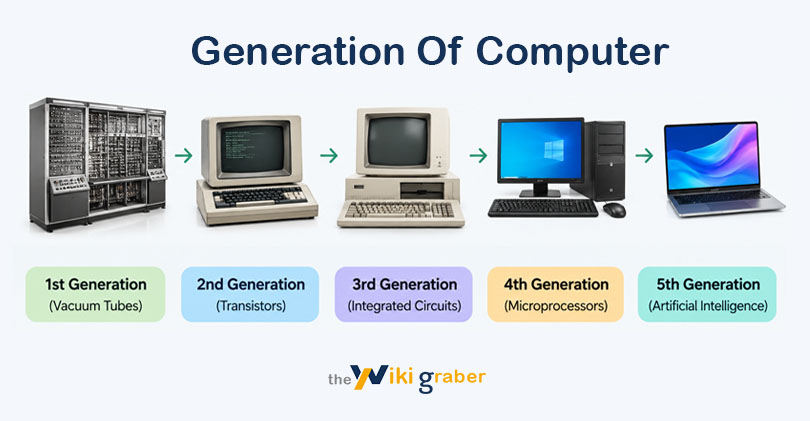
The history of the computer is quite extensive. When the first computer was invented, it was significantly different from those we see today. Over time, its limitations were addressed, eventually leading to the creation of the modern computer. The development of computers began many years ago; the process of inventing the first computer commenced around 1940. Since then, there have been five generations of computers, and the type of computer developed in the final generation is what we use today.
The concept of “generations” of computers can be understood as follows: the initial computers had certain limitations; as these shortcomings were addressed and new, improved versions were launched, each subsequent stage was classified as a new “generation.” In this manner, there have been five distinct generations throughout the history of the computer.
First Generation of Computers: 1940–1956 (Vacuum Tubes)
The very first generation of computers, which began to be developed around 1940, is known as the “vacuum tube” generation. These early computers utilized vacuum tubes and employed magnetic drums for memory. At the time of their invention, these computers were massive—often occupying the space of an entire room. Furthermore, they required a significant amount of power to operate.
When these vacuum tube-based computers were in use, they generated an immense amount of heat, which posed a major challenge for users. These issues were subsequently addressed in the second generation of computers.
Second Generation of Computers: 1956–1963 (Transistors)
The computers introduced during the second generation utilized transistors. These machines replaced the earlier computers that had come before them. They were significantly more affordable, operated at much higher speeds, and featured a more compact design. Furthermore, they generated less heat compared to vacuum-tube-based computers; however, the issue of heat generation persisted, as it was not entirely resolved. Nevertheless, these computers produced notably less heat than those of the first generation.
Third Generation of Computers: 1964–1971 (Integrated Circuits)
Computers in the third generation were built to be even smaller than those using transistors. They incorporated silicon chips, known as semiconductors. The introduction of these silicon chips was a defining feature of this generation. A major advantage of these computers was a significant increase in operational speed, along with a substantial improvement in data processing capabilities.
Additionally, this generation introduced hardware components such as monitors and keyboards for user input. Computers from this generation were made available to the market, where they were widely adopted by users.
Fourth Generation of Computers: 1971–1985 (Microprocessors)
The fourth generation of computers was characterized by the use of microprocessors. As the name suggests, these machines relied on microprocessor technology. Microprocessors were employed in this generation to further reduce the physical size of computers, making it easier to manufacture more compact units. These computers also utilized silicon chips. This ensured that there was no decline in the computer’s operational capability, while also enhancing its processing power.
With the introduction of the microprocessor, computers could easily perform complex calculations. These computers saw widespread use in the market and were quite user-friendly. They also allowed for the easy storage of data.
Fifth Generation of Computers: 1985 (Artificial Intelligence)
The fifth generation of computers was launched in 1985. Computers from this generation are also known as “artificial intelligence” computers. The influence of this generation persists to this day; in fact, the computers we use currently belong to this fifth generation.
These computers incorporated advanced technology to ensure that tasks such as calculations and data processing could be performed without any issues. Once data is input, the system carries out operations automatically, processing the provided information to generate an output.
Who invented the computer?
Millions of people contributed to the invention of the computer, but Charles Babbage is considered the father of the modern computer. Prior to his work, no mechanical computer had been developed. In 1837, Charles Babbage developed the “Analytical Engine,” which served as the foundation for the development of the computer. Over time, as limitations were identified in earlier versions, new generations of computers emerged, eventually leading to the computers we use today.
What is a computer operating system?
An operating system (OS) is responsible for managing all the tasks performed by a computer. It acts as the platform through which all programs on a computer are operated. The operating system serves as an interface between the user and the computer; it processes the input provided by the user and presents the results back to them. Furthermore, the operating system manages all the software and hardware components of the computer.
In simpler terms, the operating system can be considered the “heart” of a computer. Without it, a computer is essentially an inanimate object. An operating system is essential for running all the hardware and software within a computer system.
Advantages of Computers
In today’s world, computers are used by everyone. Here are some of the key advantages of using a computer:
- Computers allow a person to perform multiple tasks simultaneously; hence, they are referred to as “multitasking” electronic units. They also enable users to easily perform complex numerical calculations.
- Computers can execute various types of tasks at an extremely high speed, which helps save time.
- Another major advantage is that this electronic device allows users to store large amounts of data cost-effectively,
- which can then be retrieved whenever needed. Computers make it easy to keep track of financial records involving vast sums of money.
- Work performed using a computer maintains 100% accuracy; there is virtually no chance of error. While mistakes can occur during the data entry process (due to human error), the computer itself processes the provided input with complete accuracy.
- You can keep your data highly secure on a computer. Furthermore, you can protect the specific files containing your data by using passwords.
Disadvantages of Computers
While there are many benefits to using computers, there are also certain drawbacks that users may encounter. The disadvantages of using computers are outlined below:
- Computers are susceptible to various types of viruses, which can interfere with programs and cause significant issues during data processing.
- Computer systems can sometimes be compromised by hackers, leading to the potential theft of your data.
- Users may occasionally fall victim to online cybercrimes.
- Relying on computers for all types of calculations can lead to a decline in an individual’s mental arithmetic skills.
- As the use of computers continues to grow, it has contributed to rising unemployment. For instance, a single
- computer can perform the work that previously required four people, leading to an increase in unemployment across the country.
Main Unit of a Computer
As most people are aware, the CPU is often referred to as the “brain” of the computer. CPU stands for “Central Processing Unit” and is considered the main unit of a computer. Any data entered by a user is processed by the CPU, and the resulting output is then presented to the user via a monitor. The CPU is considered the main unit of a computer. Without the CPU, it is impossible to perform any task using a computer.




This is a test coment
Wow, I like this fast loading theme.
test